High Tide
High Tide is our email newsletter—a blend of surf, business strategy, design, marketing, technology, beach culture, and Internet goodness every month.

Confessions of a brand director turned TikTok creator with Joe Hodnicki
After nearly a decade working on the brand side, Joe Hodnicki made a pretty big career pivot: He traded his marketing leadership role for a phone, a mic, and a whole new world of content creation.
It wasn't a decision he'd mapped out years in advance, but after seeing the immense opportunity emerging around TikTok Shop and creator-led commerce, Hodnicki decided it was a marketing muscle he wanted to strengthen. What started with filming videos late at night while his family was fast asleep eventually turned into a full-time career as a creator working with brands across TikTok, Instagram, and beyond.
Hodnicki brings more than a creator's perspective to the table. With more than 20 years of experience in creative and marketing strategy, including nearly a decade at lifestyle brand Jetty, Joe understands what brands are trying to accomplish, what makes a campaign work, and why the traditional approach to creative doesn't always translate to the creator economy.
In the latest episode of A Better Way to Grow, Sunnyside founder Matt Raminick sits down with Hodnicki to talk about his unexpected career transition, what brands get wrong about working with creators, and why giving people more creative freedom could be the key to making better content.
From brand director to full-time creator.
Hodnicki describes himself as a “jack of all trades, master of a couple.” He's always been drawn to creative projects, whether that's marketing, design, illustration, product development, or something entirely new — and TikTok Shop quickly caught his attention.
“When TikTok Shop kind of came out and about, it just rose that flag in my mind where I was like, ‘Whoa, that is different and kind of really cool,’” Hodnicki says.
At the time, he was still looking at the opportunity through a brand director's lens. To him, creator content was another potential marketing channel — one that came with plenty of questions about control, authenticity, and whether it would actually make sense for the business.
But he couldn't shake the feeling that there was something worth exploring. So, at the beginning of 2026, he decided to give it a shot.
His first UGC experiment involved a toy his kids had received for Christmas. He started filming videos around the house, trying to see whether he could sell the product himself.
“I need to film this. I need to see if I can sell this thing,” he remembers thinking.
He ended up selling a few of the games, but the bigger takeaway was that he'd found a new marketing skill he wanted to master. “This is a marketing muscle I need to learn,” he says. “I need to dive in headfirst.”
And that's exactly what he did. Hodnicki started trying to post a video every day, learning from other creators and asking as many questions as he could as he went along. Eventually, he was spending his evenings creating content, often filming from 10 p.m. until 2 a.m. while balancing family life and his full-time job.
By June, he says, something clicked. He knew he wanted to pursue content creation more seriously. Months later, he left his full-time position to go all-in on UGC.
Why brand-side experience is a creator superpower.
One of the biggest advantages Hodnicki brings to his work as a creator is knowing what it's like to sit on the other side of the table. “I can bridge the gap between brand and creator pretty good, I think,” he says.
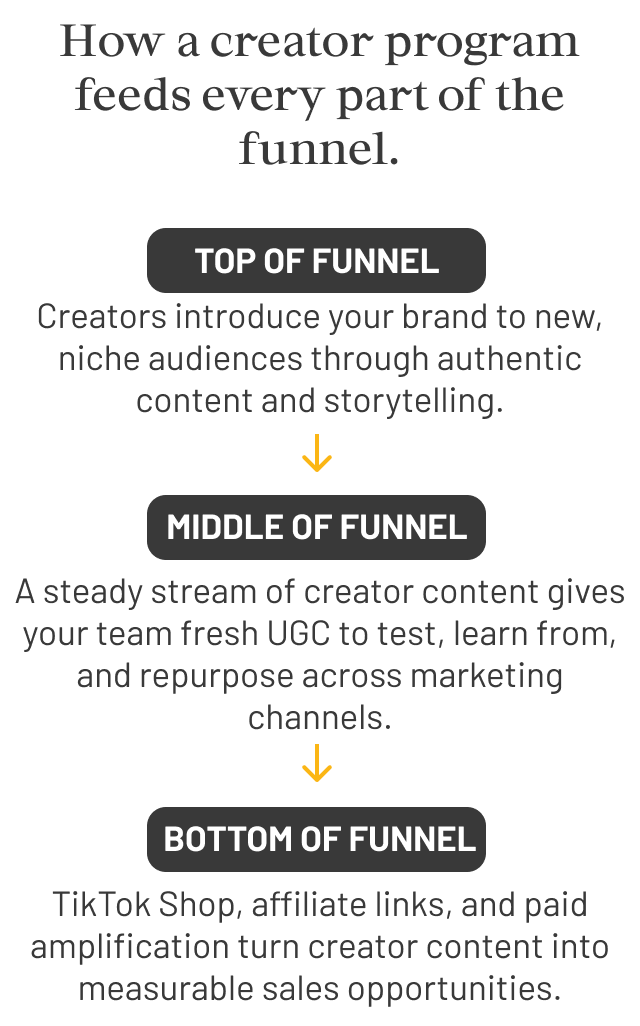
After years of working with agencies, managing campaigns, and focusing on acquisition and retention, he understands that a brand isn't simply looking for a video that gets views — it's trying to accomplish something within a much larger marketing strategy. That perspective helps him understand how creator content fits into the broader funnel.
For example, a piece of UGC might be great for prospecting and introducing a product to a new audience, while other creative assets — such as product imagery or a more direct promotional ad — help convert that interest further down the funnel.Rather than treating every video as a standalone sales opportunity, Hodnicki encourages brands to think about how creator content can contribute to the bigger picture.
“Brands that are champions on Meta and leaned in earlier on TikTok use TikTok as a way to source really great UGC creative to then run it back onto Meta to hit home runs," he told Raminick. However, that doesn't mean posting the same thing on both platforms all the time. "A lot that works on Meta does not work on TikTok, [but] a lot that works on TikTok will work on Meta," he says.
He also points out that creator content can generate awareness beyond the video itself. If a creator receives a product they genuinely like, they're likely to wear or use it in other content, creating additional exposure that isn't limited to the original sponsored post.
Brands: You might need to let go a little.
If there's one thing Hodnicki wishes more brands understood about working with creators, it's that they can't control every little detail and still expect the content to feel authentic.
“On the brand side, everything is polished, usually. Especially on the Meta side,” Hodnicki says. “And I think that is where things are shifting a little bit.”
He believes one of the biggest mistakes brands make with UGC is being too restrictive about what creators can say and how they can say it.
“I think letting people be themselves and be creative is the biggest piece,” he says. “What's happening, and from what I'm seeing, is the more control brands are having over their content, if they're trying to do the UGC side, it does not come off authentic. It does not come off genuine at all.”
That doesn't mean brands should abandon creative direction altogether. Hodnicki is quick to point out that briefs still matter, especially when it comes to making sure creators are accurately representing a product and aren't making claims they shouldn't. But there's a difference between providing guardrails and scripting every moment.
“There's a lot of room for brands to just let it happen instead of trying to control the outcome,” he says.
He points to his wife's experience as a creator as an example of where this control can go wrong. When briefs become overly detailed and restrictive, it takes the fun out of creating content — which makes it harder for creators to bring their own personality to the work. That is, after all, what you're paying for.
Hodnicki says brands that are willing to test different styles, voices, and approaches are going to be the big winners in the creator economy. A creator might communicate the value of a product in a way the brand's internal team never would have considered — and that could be exactly why the content resonates.
The creative is the targeting.
Another reason Hodnicki believes brands should give creators more freedom is that different perspectives can help reach different audiences. A creator might talk about a product from the perspective of a parent, a homeowner, an outdoor enthusiast, or someone with a very specific hobby. Those personal details can make the content feel relatable to people who share that experience — especially if it's a blind spot for the marketing team.
As Hodnicki explains, a video featuring someone talking about being a mom of three could naturally resonate with other moms in a similar situation. Another creator might talk about a product through the lens of having a mechanic in the family, connecting with an entirely different audience.
Rather than trying to manually define every audience, Hodnicki encourages brands to build a diverse creator pool and experiment with different creative angles and pay attention to the data.
“Less control, letting people be themselves, start to really trust the algorithm,” he says. “And let the content do the work.”
That doesn't mean simply publishing a bunch of videos and hoping something takes off. Hodnicki recommends looking at performance indicators like hook rate, retention, and click-through rate to understand what's working and why. With fewer manual targeting controls available, having a strong mix of concepts, creators, and creative styles gives brands more opportunities to find the right audience.
How brands can build better creator relationships.
Hodnicki has produced more than 1,200 pieces of video content for brands in just a handful of months. That experience has given him a pretty close look at what separates brands that build momentum with creators from those that struggle to get a program off the ground.
One of his biggest recommendations? “If there's people managing the expectations of the creators in a way that's, like, human, like I do, I, or I try to on the brand side, it goes a really long way," he says. Hodnicki appreciates hearing from brands when something is back in stock or when there's a new product they want him to feature. Those small reminders can prompt him to create more content, especially when he already has a good relationship with the brand.
“If the only time I'm getting correspondences is at 2:00 in the morning from a brand, I'm opening it and I'm missing it,” he says.
He also cautions brands against sending out endless samples without a strategy for what happens next. Some creators request large quantities of free products, make one video for each, and then move on to the next thing. Hodnicki even refers to the phenomenon as “sample hell.” Instead, he recommends identifying the creators who are already producing strong content and investing more deeply in those relationships.
To understand who is worth building a longer-term partnership with, Hodnicki recommends brands look at performance data, inventory levels, and a creator's existing content. On the creator end, he suggests targeting brands you think you can be a top creator for and proactively reaching out to learn what products to push.
His advice for anyone thinking about making a leap.
Hodnicki's transition into full-time content creation wasn't an overnight success story. It involved months of late nights, learning new skills, testing different approaches, and figuring out whether the opportunity could become a sustainable career. Even after making the leap, he says there were moments when he questioned whether he should keep going.
Around the three-month mark, he remembers feeling exhausted and wondering if it was time to quit. But a piece of advice from a friend in the creator space helped him push through: “If you give up now, you're gonna fail. And if you don't give up, you have a slim chance of making it.”
For Hodnicki, that perspective made all the difference. You don't need to have everything figured out before you start, and there's no guarantee that a new path will work out exactly as you imagine. But you have to give yourself the opportunity to find out.
“I think at the end of the day, just push and just don't stop until your gut tells you,” he says. “Follow the gut.”
If your brand wants to leverage a creator program but you're sturggling or not sure where to start, we're here to help. Shoot us a message at hi@sunnysidecalifornia.com.
Thank you for reading High Tide. Please forward this to your friends.
Follow us on Instagram