
High Tide
High Tide is our email newsletter—a blend of surf, business strategy, design, marketing, technology, beach culture, and Internet goodness every month.

Agency Shopping 101: How to pick the right partner & spot red flags
Hiring an agency is a little like getting married.
You're making a significant financial commitment, trusting someone with a meaningful part of your business, and — ideally — signing up for a relationship that lasts for years.
But for brands that haven't hired an agencies before, or that have been burned in the past, figuring out who to trust can be daunting. Everyone has great case studies. Everyone has a battle-tested framework. Everyone promises growth.
So how do you separate the agencies that can actually help your business from the ones that are just really good at selling themselves?
Sunnyside CEO Matt Raminick spent nearly two decades on the brand side of ecommerce and marketing, including senior roles at Quiksilver, Volcom, and PacSun, where he was responsible for hiring and managing agencies himself. That experience ultimately led him to start Sunnyside, an agency built around solving some of the problems he repeatedly saw from the brand's perspective.
Recently, Raminick visited Chase Clymer's Honest Ecommerce podcast and shared his biggest piece of advice for brands shopping for an agency. That advice is surprisingly simple:
Pay attention to how the agency sells you.
“I subscribe to the idea that the sale is a sample of the engagement,” Raminick says. “As you're going through it — getting to know these people and talking about your desired outcomes and what you're really trying to achieve — that whole process should be a sampling of what it's going to be like to work together.”
Simply put: don't just evaluate what's in the pitch. Evaluate the relationship you're experiencing before you've even signed the contract.
Start with the business problem, not the agency
One of the biggest mistakes brands make is jumping into agency shopping before they've clearly defined what they're actually trying to solve with that partnership.
Maybe sales aren't growing fast enough.
Maybe acquisition costs have climbed.
Maybe the internal team is overwhelmed.
Maybe the brand has outgrown its current agency.
Those are all great reasons to start a conversation, but they're not necessarily the same problem, and they don't necessarily require the same type of partner.
Before you start comparing agencies, get specific about what success actually looks like.
Raminick recommends thinking beyond the next quarter or the next campaign and asking:
What do we want to look back on a few years from now and feel like we accomplished?
“What is it, in a few years' time, that you really want to look back and go, ‘Yeah, we did it, we high-five over it, let's celebrate’?” he says.
A good agency shouldn't need you to hand them the answer in the form of a perfectly formatted RFP. They should be asking questions that help uncover it.
And once they understand where you want to go, they should be able to specifically explain how they think they can help you get there.
That's an important distinction between an agency selling a service and an agency acting like a partner.
Red flag: They don't ask about your numbers
If an agency is promising to grow your business without first asking how your business works or what your current results vs. expectation look like, that's a big problem.
Before recommending a strategy, a good partner should want to understand the numbers behind the business: revenue, margins, conversion rate, customer economics, historical performance, and the specific goals you're trying to reach.
They should also want access to that data.
“A good plan comes grounded in your numbers, not a templated playbook,” Raminick says. That means an agency should be interested in more than your ad account.
They should want to understand the broader business and what you're actually trying to accomplish. Who are the key stakeholders? What does the P&L look like? What's happening with the product? What's working creatively? Where does the internal team need help?
If the pitch is essentially saying: "We'll take over your ads, charge you X percent of spend, and get started tomorrow," without much curiosity about the business underneath it, that's worth pausing over.
The best agency relationships start with a shared understanding of what the business needs — not a prepackaged service looking for somewhere to land.
Red flag: The case studies don't look anything like your business
Case studies are one of the first things most brands look at when evaluating an agency, but you shouldn't just ask whether the numbers look impressive.
Ask whether the problem looks familiar.
“If you're a CPG brand, cool, you should find a CPG agency. If you're an apparel brand, find one that has tons of apparel clients,” Raminick says.
An agency that helped a B2B lead-generation company double its leads may have done excellent work. But that doesn't necessarily tell an apparel brand anything about the agency's ability to grow an ecommerce business.
The closer the overlap between the case study and your actual business, the more useful the proof becomes.
That means looking for similarities in things like Industry and business model, product category, company size and stage, growth challenges, customer acquisition model, revenue scale, and business goals.
And then look closely at what the agency is actually measuring.
A case study that leads with ROAS, impressions, clicks, or other channel metrics may sound impressive. But those numbers don't necessarily tell you whether the agency helped grow the underlying business.
“They should really show some tangible outcomes and how they contributed to overall business growth,” Raminick says. “A lot of times, you see stuff like, ‘Yeah, we got this great ROAS,’ or, ‘We got all these impressions’ — and that stuff's great, but that's really just them patting themselves on the back a bit.”
The better question is: What happened to the business after the agency got involved?
Did the brand grow from $15 million to $25 million? Did profitability improve? Did the agency help create a sustainable acquisition engine? Did they help the internal team get to a place where it could operate more effectively?
That's the scorecard that really matters.
A good agency will put in the work to make the strategy specific to your business. Raminick says that at Sunnyside, the goal is to illustrate “what that bridge to success looks like” during the sales process.
Green flag: They want to get their hands dirty
One of the clearest signs that an agency is taking your business seriously is what they ask to see before they make recommendations.
Raminick says a strong partner should want access to your accounts and historical data before making recommendations and changes.
“They should want to get their hands dirty looking at historical data before really touching anything, and asking about your business objectives, what's going on with the brand, what else you have going on," he says.
That's an important distinction. A templated pitch can be built without knowing much about your business. A thoughtful strategy can't.
A great agency should be trying to understand not just what happened, but why it happened. What worked? What didn't? What has already been tested? What does the customer look like? What is the business planning for the next six months? What constraints are coming?
They should absolutely be talking to the people who actually understand those things.
At Sunnyside, Raminick says that includes talking directly with the CFO or other business leaders about their objectives and the numbers behind them.
The goal isn't to create more meetings for the sake of meetings. It's to make sure the strategy is grounded in the reality of the business.
Red flag: The person who sold you disappears
Here's one that anyone who's worked with an agency has probably experienced: You spend weeks getting to know the senior team, you're impressed by their ideas, you sign the contract — and suddenly you're introduced to someone or a team you've never met who will actually be doing the work.
Raminick has been on the receiving end of that experience himself.
“I was a young marketing manager at Quiksilver, and we're getting pitched by a big agency, and next thing you know we're in go mode, and it's like, ‘Okay, who are you? You're not the person I talked to originally.’”
That's not necessarily a dealbreaker in every agency relationship. Larger agencies have different structures, and senior leadership can't be on every account.
But brands should understand who will actually be doing the work before they sign.
Ask to meet the team. Who will be your day-to-day contact? Who is responsible for strategy? Who handles execution? Who makes decisions? How involved will the people in the pitch actually be after the contract is signed?
Then pay attention to whether the answers match the people you're meeting.
At Sunnyside, the people a prospective client meets are the people who actually work directly on the account.
That's not the only way to structure an agency, but it is an important thing to understand before you commit.
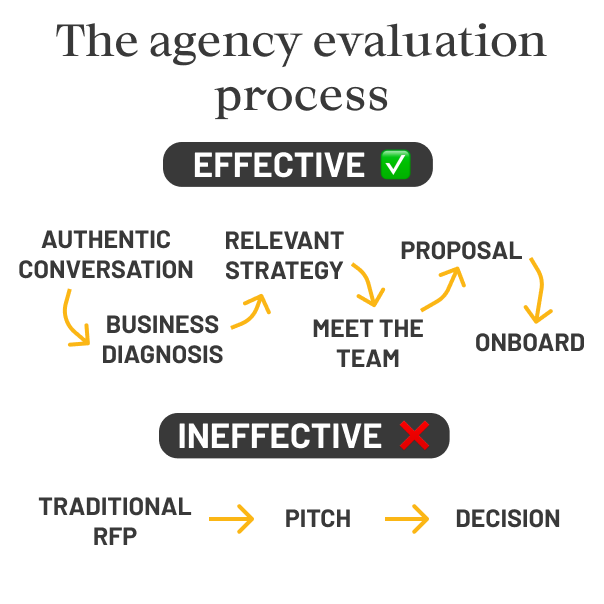
Don't RFP your way into a bad partnership
RFPs can make agency shopping feel organized: Get the brief. See the scope. Answer the questions. Pick the winner.
The problem is that an RFP can create the illusion that you're evaluating agencies on equal terms when you're often evaluating their ability to respond to a document.
Raminick's view is that brands are better served by having candid and authentic talks first.
“Generally, when it comes to RFPs especially, they're just not an effective way to hire an agency, and we don't typically respond to them” he says. “The mistake is not having the conversation first, and then talking realistically about where the business is at and where you're trying to go.”
That doesn't mean brands shouldn't do their homework. It means the process shouldn't become so formalized that you lose the human part of choosing a partner — you're going to be working with these people a lot, and you need to make sure you will enjoy it.
“Having a messy conversation, or just a realistic conversation, is going to be more telling than a response to an RFP that's just generated by AI with a couple tweaks to it," says Raminick.
Your first 90 days are a test
You've made your choice. You've signed the contract. Now comes the part that can tell you whether you made the right decision.
Raminick says an agency's first 90 days should be about getting deeply embedded in the business — not immediately changing everything.
A strong agency should have a clear onboarding process, dedicated people responsible for gtting everything up and running, and a plan for understanding what has already happened before deciding what needs to change.
That includes working collaboratively with the outgoing agency or internal team, digging into historical performance, understanding the creative that's already been produced, and getting the data and channel infrastructure connected quickly.
“They're really getting their hands dirty when it comes to the creative, trying to understand what's worked and what hasn't,” Raminick says. “The smoother the onboarding has gone, and it really felt dialed in, generally that turned out to be a great relationship over a long period of time."
The opposite can be telling, too.
“If things kind of feel hectic, and you're coming in and it's a bit disheveled, then that might be a red flag right away," he adds.
Sometimes, you actually don't need an agency
There's one more question brands should ask before they start shopping: Do we truly need an agency right now?
Sometimes the answer is no.
For an early-stage brand that's still figuring out product-market fit, identifying its customer, and getting the basics off the ground, bringing in a full-service agency can create more complexity — and expense — than the business needs.
Raminick knows firsthand that sometimes a freelancer who can wear a few different hats might be the better fit for an early-stage brand.
He himself got his start building what would eventually become Sunnyside by consulting for small startups and helping them figure out ecommerce and digital marketing from the ground up.
When he began working with beek, a women's sandal brand, it was still doing low six figures. Today, the brand is well into nine figures, and a 6+ year Sunnyside client.
The other scenario where a brand might not need an agency is when the real problem is inside the organization: marketing and buying aren't communicating, inventory doesn't line up with the marketing calendar, there's confusion around who owns what.
Those aren't necessarily agency problems.
“If the problem they're trying to solve is actually internal... that's an org fix, not really a media or agency fix,” Raminick says.
Bringing in an agency won't automatically fix a business that isn't aligned internally. So before you start looking outward, take a hard look inward.
The right agency should feel like a partner
There are plenty of agencies that can run ads, build websites, manage email, or execute a marketing plan, but that's not necessarily what brands are actually looking for when they say they want a growth partner.
They want someone who understands the business.
Someone who cares about the goals behind the marketing.
Someone who can tell them when the problem they're trying to solve isn't actually a marketing problem.
And someone who is invested in the people they're working with, not just the account they're managing.
That's something Raminick says has become central to how Sunnyside approaches client relationships.
“When we move into a new engagement with a brand and figure out who our key stakeholder is... it's our personal goal to get that person promoted,” he says. “How can we really sink into what this person's goals are as an individual, and then help them achieve that, in addition to some of the business objectives?”
That's a very different definition of an agency relationship.
Instead of asking only, What can this agency do for our business? the better question might be:
Can we see ourselves working with these people for the next three to five years?
Because if the answer is yes, you've probably found something more valuable than a vendor.
You've found a partner.
Thank you for reading High Tide. Please forward this to your friends.
Follow us on Instagram