
High Tide
High Tide is our email newsletter—a blend of surf, business strategy, design, marketing, technology, beach culture, and Internet goodness every month.

Why Most Retention Problems Start in Acquisition w/ Johnny Gothard of Seager Co
For most brands we work with, acquisition and retention are treated as separate entities.
The default is that acquisition is measured on ROAS and CAC, and retention on repeat purchase rate and LTV. The two functions report up through different stakeholders, and they rarely interrogate each other's assumptions.
And the problem with that structure is that it overlooks the single biggest variable in retention performance: exactly which customer you’re getting in acquisition.
For example, the LTV of someone who comes to buy a pair of socks going viral on TikTok is probably very different from someone who comes to buy (say) snowboard bindings.
We were thinking about this recently with Johnny Gothard, Ecommerce Director at Western apparel brand Seager Co. As he put it:
"This might be kind of a weird answer, but recently I'm almost looking at acquisition through the lens of retention."
It isn't actually a weird answer at all!
It's the answer the more brands are starting to converge on, and it has big implications for how brands think about marketing.
What’s wrong with ROAS?
Optimizing for ROAS is the default for most brands: set a blended target, build campaigns toward it, reward the channels and creatives that produce the lowest-CAC conversions, and measure success on how many new customers you bought for the dollar.
It seems to make sense: you want the most customers at the lowest cost, right?
Well, not quite: if those customers just buy and bounce, all you did was subsidize their discount.
As Johnny says:
"If you're super focused on ROAS, these people are getting a big discount. You're acquiring new customers, but they're low quality. That's going to affect retention."
Johnny's point lands because it names a dynamic most brands have felt but haven't fully measured.
To be specific, think about the likely LTV of customers that were:
- Acquired via a 30% off code vs acquired via an organic search for the brand name
- First purchase was the on-sale clearance hat vs the heritage outerwear piece the brand is actually built around
Both show up in the acquisition dashboard as a new customer, but their downstream behavior is radically different.
And if you’re not careful, you’re effectively bidding on the customers least likely to come back.
The cheapest customer to acquire is, with depressing regularity, also the worst customer to have.

Measure what actually matters: LTV
So what do you actually DO with this? Johnny’s take says it all:
"Having more of a lifetime value focus on acquisition would probably be the quick answer."
In practice, this means measuring the thing that actually matters: LTV, not CAC or ROAS.
Put simply, you’d probably be better off paying $50 for a $500 customer than $20 for a $25 customer.
The most productive metrics we’ve seen are the same two Johnny is now running at Seager, looking at repeat purchase rate and LTV cut by:
- First-purchase product category
- Acquisition channel
Almost every brand already has this data, and looks at it as part of their retention reporting.
What Johnny’s pointing at is using that to optimize acquisition: letting them drive media buying and creative decisions, rather than just part the retention team's review deck.
What the data tends to show
When you actually do the work of segmenting LTV by first-purchase category, the picture is usually more lopsided than people expect.
"It's interesting how different product categories have a much different lifetime value. If your first purchase is a hat versus a jacket or a short sleeve button up."
We're seeing the same thing with Brixton, where we've been getting deep into new customer cohorts: what they buy first, what they come back for, and how the pattern varies by acquisition channel.
The shape that keeps showing up: some product categories are essentially one-and-done, others tend to drive long-term customers with great LTV.
Clearly, one cohort is worth much more than the other - but very few brands we’ve audited are using LTV to bid differently on product categories.
In aggregate, that means they’re overpaying for the customers who churn fastest and missing out on customers who would have become their best.
What this changes downstream
Once a brand has the LTV-by-first-purchase view, three things tend to shift.
Media buying gets stratified
Every product has its own ROAS target. Gateway products can sustain higher CAC because they're paying back over a longer horizon.
The one-and-done products either need to clear their economics on the first transaction, or come out of the prospecting mix entirely.
Creative strategy gets more focused
We see plenty of brands whose best-performing ads are running for products that turn out to be retention dead ends.
But once you have the data to spot that, you know exactly where to focus: if the gateway products are doing the long-term value creation, the strongest creative should be built around them.
Email and lifecycle get sharper
The customer who comes in via a high-LTV category should be flowed differently from the customer whose first purchase was a one-and-done category, both in timing and in what gets recommended.
This is the kind of work that's actually built around behavioral data rather than demographics, and it's where the meaningful gains in repeat purchase rate tend to live.
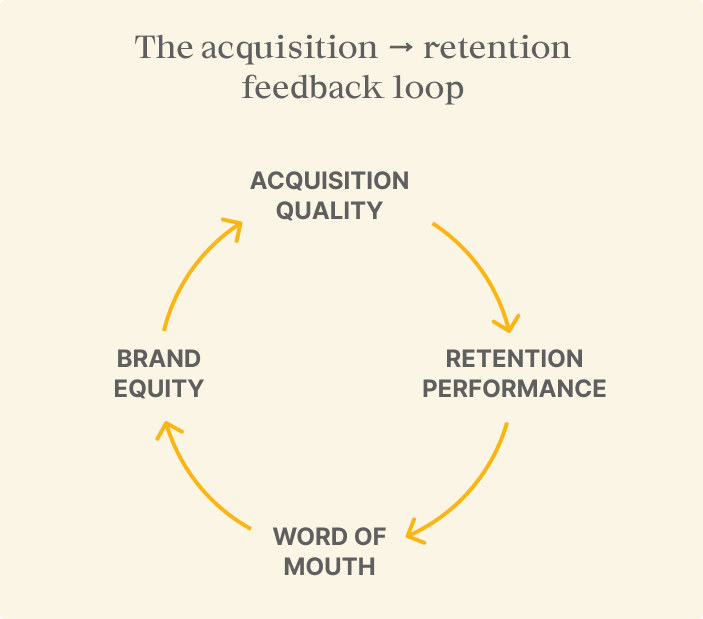
The acquisition → retention loop
The really critical thing to understand is that this is much bigger than just optimizing CAC:LTV on the campaigns you’re running today.
It’s a feedback loop, where retention quality feeds back into future acquisition costs for years or decades.
A loyal customer doesn't just come back. They talk about the brand. They show up in friends' feeds wearing the product. They contribute to organic search volume, direct traffic, and the kind of brand-driven demand that lowers blended CAC over time.
The brands that scale up over the long arc tend to be the ones that figured this out. The brands that plateau tend to be the ones that didn't.
As Johnny put it:
"If you're not keeping those customers and getting people to come back, you're just going to end up spending a lot of money bringing people to you that just buy once."
So the full loop looks like this:
Acquisition quality → Retention performance → Word-of-mouth → Brand equity → (repeat)
The brands that run this loop intentionally end up with structurally lower acquisition costs over the long term.
Not because they got better at media buying, but because they got better at picking the right customers to acquire in the first place.
So, where do you start?
There's no single formula here.
Every brand has different categories, price points, repeat purchase cycles, and different operational capacity to act on what the data shows.
That said, our general approach to this work tends to start with the same three pieces:
Run the segmentation
Pull a 12-18 month window of new customers, segment them by first-purchase product category, and measure repeat purchase rate and average LTV by segment.
Almost every brand we've done this exercise with has surfaced at least one surprising finding — usually a gateway category that was being underinvested in, or a one-and-done category that was eating a disproportionate share of paid budget.
Cross-cut by channel
The same exercise, but segmenting by acquisition source: paid social, paid search, organic, email signup, direct, referral.
Different channels bring in different qualities of customer, and once you can see channel variance and product-category variance in the same view, the media allocation picture changes.
Use the output to actually reshape spend.
This is the part most brands skip. The analysis lands in a deck, gets nodded at, and the media buying continues on its existing unified ROAS targets because that's what the dashboards are built for and that's what the team is being measured on.
The brands getting the real benefit from this work are the ones who let the segmentation reshape what gets promoted, to whom, at what CAC tolerance- and who are willing to update the internal scorecard to match.
The takeaway
The reason acquisition and retention have historically been treated as separate disciplines is mostly organizational — they sit in different teams, with different tools, on different reporting cadences.
But the brands that come out ahead over the next few years are going to be the ones that treat them as a single discipline measured at different time horizons.
Or, more simply: stop asking what a customer cost to acquire. Start asking what they're worth.
Let the answer rewrite the way you go get the next one.
Thank you for reading High Tide. Please forward this to your friends.
Follow us on Instagram