High Tide
High Tide is our email newsletter—a blend of surf, business strategy, design, marketing, technology, beach culture, and Internet goodness every month.

How brands can actually make their creative stand out this Q4 with Giann Quijano
Every brand is fighting for attention during Q4. Between Black Friday promotions, holiday gifting campaigns, and an endless scroll of paid social ads, standing out is harder than ever — especially when everyone seems to be running the same offers and leaning on the same creative playbook.
So what does it take to make holiday creative actually work? For creative strategy expert Giann Quijano, the answer isn’t necessarily a bigger production budget or another new channel. It’s about getting strategic with your offer, knowing when and how to deploy different types of creative, and giving customers a reason to care.
Sunnyside's founder Matt Raminick caught up with Quijano to talk about how brands can cut through the Q4 noise, why the simplest creative can be the most effective, and how authentic storytelling can help brands stand apart in a sea of increasingly artificial content.
Check out the full conversation, and read on for more info:
Big and boring can be better.
During Q4, nearly every brand has some kind of promotion. That means a beautiful ad or clever concept alone may not be enough to convince someone to buy. The offer needs to give customers a clear reason to act — and the creative needs to make that reason immediately obvious.
“Big design always wins,” Quijano says, pointing to the importance of keeping promotions easy to understand. Complicated offers, multiple tiers of discounts, and a different deal every day can create unnecessary friction for shoppers. If customers have to work to understand what they’re getting, you may lose them before they ever make it to checkout.
Instead, Quijano recommends making the value proposition crystal clear. If you’re offering a sitewide discount, say so. If there’s a gift with purchase or another incentive, make it easy to understand. And when it’s time to push a major holiday promotion, don’t bury the offer beneath layers of design.
As Raminick notes, bold typography and solid-color backgrounds consistently perform well during these moments. While that straightforward approach might make a brand’s design team cringe, Q4 is a time when clarity can matter more than creative complexity.
“Big and boring is better,” Quijano insists.
Give your creative a head start.
If you want your holiday creative to stand out, waiting until Black Friday week to launch your campaign can limit your options. Quijano points to a first-mover advantage for brands willing to start earlier and build momentum around their offers.
The earlier you begin, the more room you have to introduce the promotion in different ways rather than relying on one message for the entire sale period.
For brands with a more developed creative program, Quijano suggests using creators early in the campaign to introduce the holiday offer. A mix of creators talking about the brand can help build awareness and get the promotion in front of different audiences before the biggest shopping days arrive.
As the campaign progresses, brands can introduce more targeted incentives, such as a gift with purchase or early access for customers who join an email list. Then, as the main sale approaches its final stretch, the creative can become more direct, with a stronger offer and a clear reason to purchase now.
Make the offer and the customer experience match.
Even the strongest creative can fall flat if the experience after the click doesn’t live up to the promise.
If an ad promotes a specific discount, shoppers should be able to find that offer on the site without having to hunt for it. And if a product is the hero of a campaign, the brand needs to make sure it has enough inventory to support the promotion.
That alignment starts well before an ad goes live. Quijano encourages marketers to understand their inventory position and work with their operations teams to build offers around products the business actually needs to move — not just the products the creative team likes featuring.
For apparel and lifestyle brands in particular, that means knowing which sizes and products are available, where inventory is sitting, and what the business needs to sell through. A promotion that sends customers to an out-of-stock product or introduces an unexpected offer at checkout can create frustration instead of sales.
Creative strategy also shouldn’t stop at the ad itself. Quijano points to opportunities to improve the broader shopping experience with incentives such as gifts with purchase or spend thresholds that unlock additional rewards. The goal is to look at the full journey, from the first impression to the final purchase, and find places where creative thinking can reduce friction and improve results.
As Quijano puts it, “Your job isn’t to just find the attention and get the click, but also to attract the conversion.”
Don't let AI make your brand sound like everyone else.
AI has made it easier than ever to produce content at scale, but as more brands lean on similar tools and formats, that flood of content could make genuinely human storytelling more valuable than ever.
Quijano expects audiences to see plenty of low-quality, artificial-feeling content this holiday season — and believes brands have an opportunity to stand apart by leaning into what AI can’t authentically replicate: the real people behind the business.
“Don't add to the AI slop,” he says. “Stand f--king apart from it.”
For Quijano, that could mean putting a founder or CEO in front of the camera and letting them tell the brand’s story in their own words. A founder walking through a warehouse, talking about the products, or explaining what the team is excited to share with customers can offer a level of credibility that a manufactured spokesperson simply can’t.
It’s also an opportunity to make a brand feel more personal at a time when shoppers are being bombarded with polished promotions and synthetic-looking content.
That doesn’t mean brands should ditch creators or user-generated content. Instead, they should think more carefully about who is telling the story and why that person is the right voice for the brand. Quijano sees an ongoing opportunity in creators with niche audiences and genuine connections to the communities they serve.
Think beyond the ad itself.
Creative performance isn’t determined by the image or video alone. The offer, landing page, shopping experience, and the way customers move through the funnel all influence whether an ad ultimately drives a sale.
Brands should look beyond click-through rates when evaluating their creative. An ad can attract plenty of attention without producing the conversions the business needs. Understanding what happens after the click can reveal whether the problem is the message, the offer, the product, or the buying experience.
Quijano encourages marketers to think creatively about the entire path to purchase — including how incentives work on the site, what customers see in their carts, and where they might encounter barriers to completing an order.
It’s also a reminder that a creator program can have value well beyond paid social. Content can support organic marketing, the website, and other parts of the customer experience, making a well-built creative program an investment that benefits multiple teams.
For brands, that requires a more connected approach to creative and performance. Instead of treating every ad as an isolated experiment, look at how the pieces work together to support the business.
Give people a reason to buy — and a reason to remember you.
Q4 is noisy by nature, and no single creative format guarantees success. But brands don’t have to out-produce every competitor to get noticed.
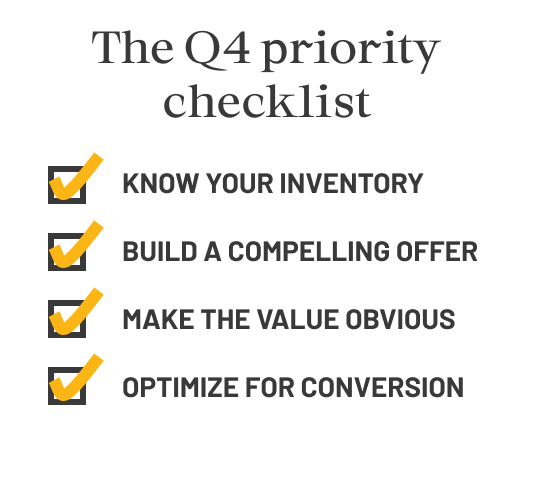
Start with a compelling offer. Make the value easy to understand. Give your campaign enough time to evolve, and make sure the experience after the click delivers on what the ad promised. Then look for opportunities to tell a more human story — whether that comes from a founder, a creator with a genuine connection to your audience, or the people who make your brand what it is.
The strongest creative isn’t just the content that gets someone to stop scrolling. It’s the content that gives them a reason to take the next step.
And in a Q4 feed full of lookalike promotions, a clear offer and an authentic point of view can go a long way.
Need some help? Shoot us a message at hi@sunnysidecalifornia.com.
Thank you for reading High Tide. Please forward this to your friends.
Follow us on Instagram