High Tide
High Tide is our email newsletter—a blend of surf, business strategy, design, marketing, technology, beach culture, and Internet goodness every month.

What brands get wrong about retention with Sean Christman of Proper Growth
For most ecommerce brands, retention starts after the customer buys.
That sounds obvious — A customer makes a purchase, and then the retention team kicks in with an email, an SMS, a loyalty offer, or maybe a discount designed to bring them back for order number two.
But according to Sean Christman of Proper Growth, that's not really retention.
“Oftentimes, folks think about retention as send more emails, send more SMSs. I've got a loyalty program. I'm doing retention,” says Christman, who spent the past decade working in ecommerce, including as part of the founding team at Cuts Clothing, before moving to the agency side with Proper Growth.
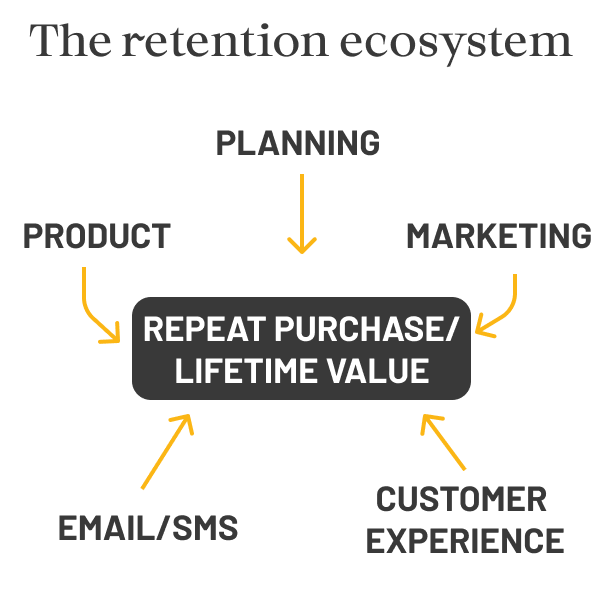
The better way to think about retention, he argues, is as an ecosystem designed around the assumption that a customer is going to stick around.
That means understanding what happens after the first purchase, what customers are likely to want next, and — perhaps most importantly — creating the conditions that make that next purchase not only possible but easy.
Because "the ads don't stop when someone buys," Christman points out. Your customer is still being marketed to by every other brand in their inbox, on their feed, and across the internet.
The question is: What are you doing to give them a reason to come back to you?
Retention isn't a channel
One of the easiest mistakes brands can make is treating retention like a line item on the marketing plan.
Send X emails per week. Send X SMS messages. Launch a loyalty program. Set up an abandoned cart flow. Check the retention box.
But none of those things, on their own, actually create retention.
As Christman puts it, email and SMS are better thought of as the mechanisms that allow brands to “harvest” returning customers. The more important question is whether the brand has something worth coming back for.
“You need to have what they're going to buy there,” he says.
That sounds simple, but it changes how brands should think about the entire customer journey.
If someone makes their first purchase today, what happens over the next 30, 60, or 90 days? Think about what product they're most likely to want next. Is there a new launch, color, seasonal product, promotion, or complementary item that gives them a natural reason to return?
Retention starts by answering those questions, not by deciding how many emails to send.
Set your first 90 days up for success
Christman thinks about retention in terms of creating a “season of success” for each customer cohort. That starts with understanding what happens after acquisition.
A customer comes in through a particular product or campaign. They have their first experience with the brand. Then what?
“The question is, what is the ideal condition for that consumer?” Christman says.
That first 90 days can be especially important because the customer has plenty of opportunities to move on. They're still being exposed to competitors, new products, and thousands of ads after they've made their purchase.
Your job isn't simply to remind them that you exist. It's to continue the experience that made them want to buy in the first place.
The specifics will vary dramatically depending on the business. A subscription brand has a very different retention model than an apparel company or a consumer electronics brand. But the principle is the same: understand your customer's behavior, then build the journey around it.
That also means looking backward.
Which cohorts have the strongest retention? What did those customers buy first? What did they buy next? How long did it take them to come back?
Those answers can tell you far more about how to improve retention than an arbitrary email cadence ever could.
Your next purchase starts with your first purchase
The most useful retention data isn't necessarily the data that tells you whether customers are coming back. It's the data that tells you why.
Christman recommends looking at the strongest-performing cohorts and working backward from their behavior.
If a particular product consistently brings in customers who make a second purchase, that's valuable information. If customers who buy Product A tend to come back for Product B within a certain period of time, that's even more valuable. Now you've got something that can influence the next marketing plan.
Instead of asking, “How do we get this customer to buy again?” you're asking a more useful question:
“What would naturally come next for this customer?” That distinction matters.
A retention strategy built around generic reminders treats every customer the same. A strategy built around real customer behavior can create a much more intentional journey.
And those learnings shouldn't stay inside the CRM team. They should make their way into product planning, merchandising, creative, marketing, and forecasting.
Imagine a brand looking ahead to its spring product calendar. It has just acquired a large cohort of customers during Q4. Rather than simply planning the next acquisition push, the team can ask: What are those customers likely to want next?
What will continue the experience that made their first purchase successful?
“Rather than bank on, ''I'm just gonna go get the next,” Christman says, brands should be thinking about how to keep the customers they've already worked so hard to acquire.
Retention doesn't belong to one team
There's another reason retention can be difficult: it doesn't actually belong to one department.
The traditional ecommerce process can look something like this:
Product develops something new. Finance determines the target. Operations figures out how much inventory is needed. And eventually, the plan lands on marketing's desk with some version of: Go sell this.
By that point, everyone may already be working from different assumptions.
Marketing may have discovered that a certain product or message is performing exceptionally well. Operations may not have enough inventory. Product may already be working on what's coming next. Finance may be working from a forecast that doesn't reflect what customers are actually doing.
Christman sees this as a communication problem, and retention is especially vulnerable to it.
If marketing knows customers who bought one product are highly likely to come back for another — but that second product won't be available for six months — the retention opportunity is already being compromised.
The same thing happens in reverse. A product may be planned and purchased without marketing having enough time to build the story around it, create content, or understand how customers are likely to respond.
“It's a sequencing issue,” Christman says. "The way to combat that is just to start earlier. Start the conversation earlier, and include more folks in that conversation."
The goal isn't to create a perfect forecast. In fact, Christman points out that the one thing everyone knows about a forecast is that it will be wrong.
The goal is to make it "less wrong" by continuously incorporating what customers are telling you.
That means using current customer behavior to inform what's coming next — and allowing those learnings to travel across the organization.
Don't just acquire the next customer
There is an obvious financial reason to care about all of this: Acquiring a customer is expensive. If you've already spent the money to get someone through the door, the opportunity is to make that initial investment work harder.
That's where LTV and CAC come into the conversation.
But even here, Christman cautions against treating retention as a simple formula.
It's tempting to look at a cohort's retention after month one, month two, or month three and assume that the trajectory will continue indefinitely. Instead, brands need to understand their actual customer behavior and when that customer is likely to pay back the initial acquisition investment.
Is that 60 days? 90? 120? Once you know that, you can start planning around it.
Christman recommends using the marketing, product, and brand calendars to create the best possible conditions for LTV to build during that period.
You're not simply hoping the customer comes back. You're setting up the business so that they can come back.
And that's an important distinction when capital is tight and brands can't afford to treat every new customer like a one-time transaction.
What brands should be looking at right now
So what does this actually look like in practice?
For starters, brands should take a close look at their recent cohorts and ask a few basic questions.
Which customers are coming back?
Don't just look at an overall retention percentage. Identify the cohorts that are outperforming and figure out what they have in common.
What did those customers buy next?
Your best retention strategy may already be hiding in your customer data. Look at the products, timing, and behaviors that lead to a second or third purchase.
What's available when they're ready to come back?
This is where retention becomes an operational issue. If customers are primed to make another purchase but the product isn't available, no amount of email optimization is going to fix the problem.
What is the business planning to give them next?
Retention should have a seat at the table when product and marketing calendars are being built. The customers you're acquiring today should influence what you're planning to sell them tomorrow.
And finally, what can you learn from each cohort and feed back into the next one?
The goal isn't to create a perfectly predictable customer journey. It's to get smarter with every cycle.
The Takeaway
The easiest way to think about ecommerce growth is as a series of new customers.
Acquire. Convert. Acquire some more. Keep the machine running.
But that can become an expensive treadmill.
The more powerful model is one where each purchase creates information that helps make the next purchase more likely.
You acquire a customer. You learn what they respond to. You understand what they buy next. You make sure that product is there when they're ready for it. You give them a reason to return. And then you use what you learn from that customer to improve the experience for the next cohort. That's how retention starts to compound.
It also explains why retention isn't something that can simply be handed off to the person managing email. It's a business-wide exercise in understanding your customer and preparing the organization to serve them again.
“Really, what it is is setting up those folks with the ability to come back,” Christman says. That's a much more useful definition of retention.
Because the goal isn't to send more messages.
The goal is to build a business customers have a reason to return to.
And when you do that well, retention doesn't just make acquisition more efficient. It becomes one of the things that makes growth possible in the first place.
Thank you for reading High Tide. Please forward this to your friends.
Follow us on Instagram
.jpg)