High Tide
High Tide is our email newsletter—a blend of surf, business strategy, design, marketing, technology, beach culture, and Internet goodness every month.

The Membership Playbook: How Florence Marine X Turned "Loyalty" Into Something People Actually Want
Let’s be honest: most ecommerce “loyalty” programs are really just discount programs.
You turn on some out-of-the-box, whitelabeled tool. Customers earn points, points convert to dollars off, and over time you've done nothing except train your best customers to expect a discount they didn't expect before.
That model doesn’t actually create loyalty at all… if anything, it makes the relationship more transactional!
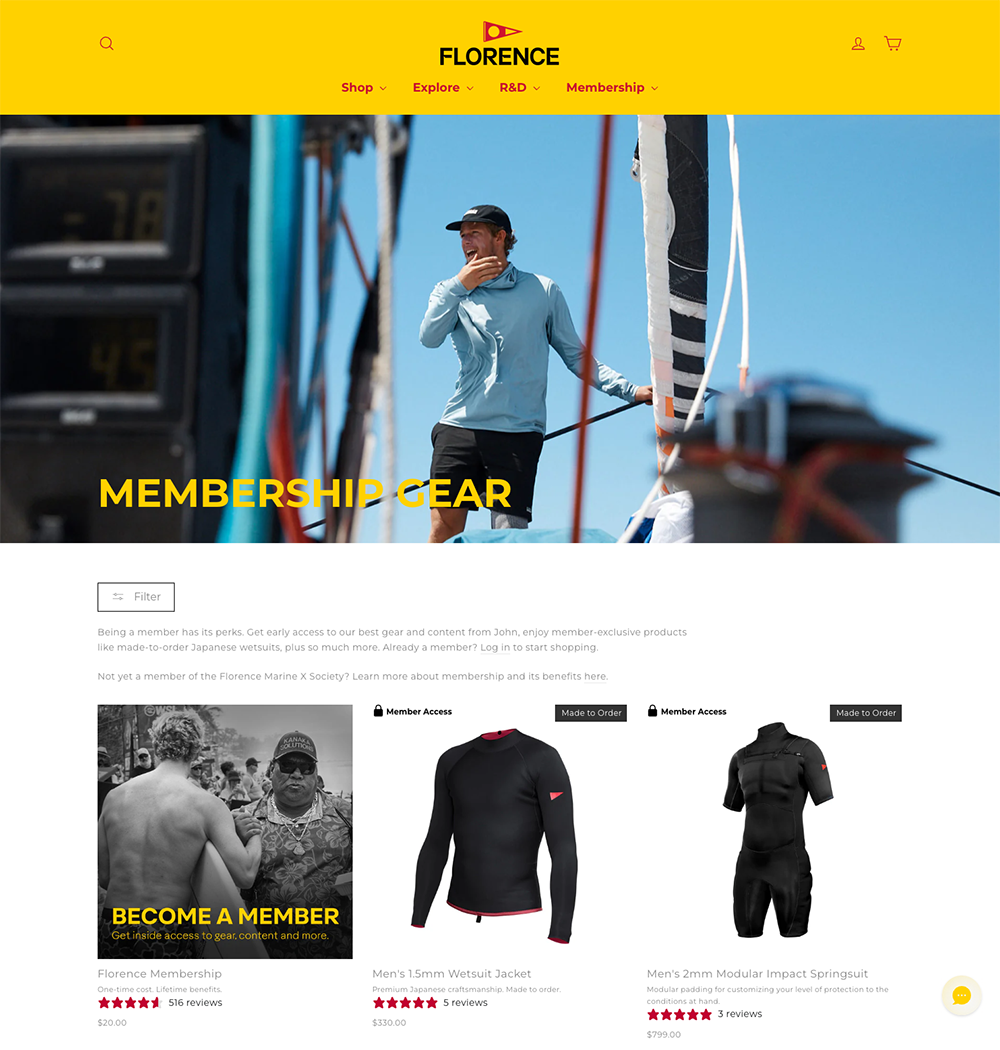
Which is why we love the way they do loyalty at Florence Marine, which might be the best membership program in apparel: Triple-digit growth, a thriving 1,000+ person private Discord community, and a product-feedback engine - all on the back of a $20, one-time membership that you get right away as cash back.
So how did they do it?
Here’s the playbook, pulled straight from my notes on a chat with Shawn Grant, former Head of Brand at Florence, through its breakout years.

Start with the thing most programs skip: actual value
Florence's membership costs $20 for life. You get that $20 back immediately as credit on your first order. You get 10% back on everything else. You get member-exclusive content from John John Florence and Nathan Florence. You get member-exclusive product. And when Florence does run a sale (which Shawn was emphatic about only doing twice a year) it's members-only.
That last part is the one most brands won't copy, because it's the hardest one: Florence made a deliberate choice to stay off the promotional treadmill. No site-wide 20% off emails. No "WELCOME15" codes floating around the internet. When the sale happens, it happens for the people who paid to be there.
"Most people use membership as just a loyalty thing," Shawn told me. "A lot of the time it's just cloak and dagger to get email signups. People say words like 'conversation,' 'community,' and 'membership' all the time and never mean any of it. They just mean give me your email."
But Florence rejects that shallow, transactional definition: their members are an authentic community of people who truly love the brand.
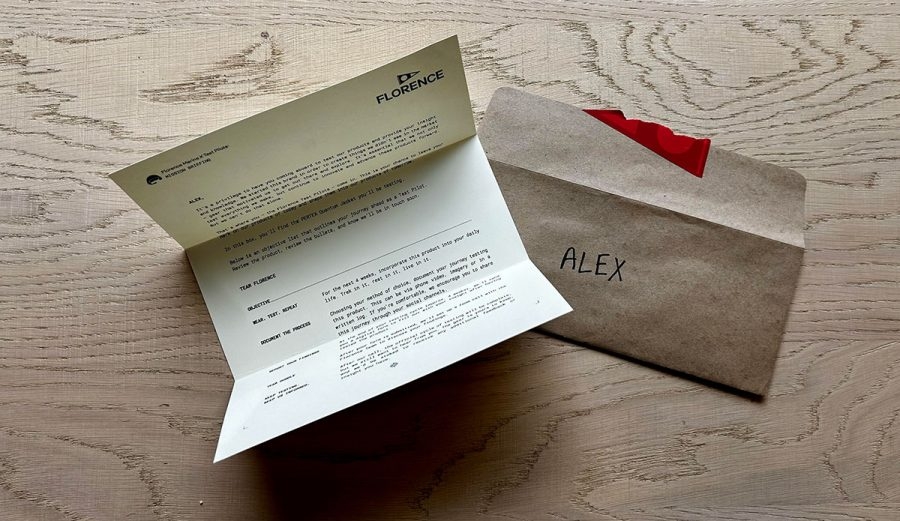
Photo via The Intertia
Make the onboarding tactile
Here's where it gets interesting. When you sign up, Florence mails you a heavyweight camo envelope. Inside is a burgee sticker that is not available anywhere else — you can't buy it, you can only earn it by being a member. The envelope is printed with "MORE THAN A MEMBERSHIP" in yellow type, and a QR code. You scan it, and up comes a video of John John, shot on his catamaran in Fiji during a family trip, thanking you personally for joining.
I've spent my career in performance marketing, and I'll be the first to admit that none of this looks like "performance." There's no UTM you can slap on a sticker. But think about what it actually does:
The sticker ends up on someone's truck, their Yeti, their surfboard. Now they're walking advertising — but more importantly, they're a visible signal to other Florence customers that there's a community and they belong to it. Shawn described members spotting the burgee on each other at Huntington Pier and striking up conversations. You can't buy that kind of organic touchpoint with a Meta ad.
"Tactile experiences are just so important," Shawn said, "especially in the wake of COVID. Just the psychological anchor of people being able to put that sticker on their thing — because there's one sticker you can't buy it — it's like this thing where people go, 'Wow, I'm part of the crew.'"
For apparel brands, this is a cheap unlock. The marginal cost of a well-made sticker and a heavyweight envelope is a few dollars. The value is a customer who now has a physical object in their life that represents your brand, reinforced every time they reach for their keys.
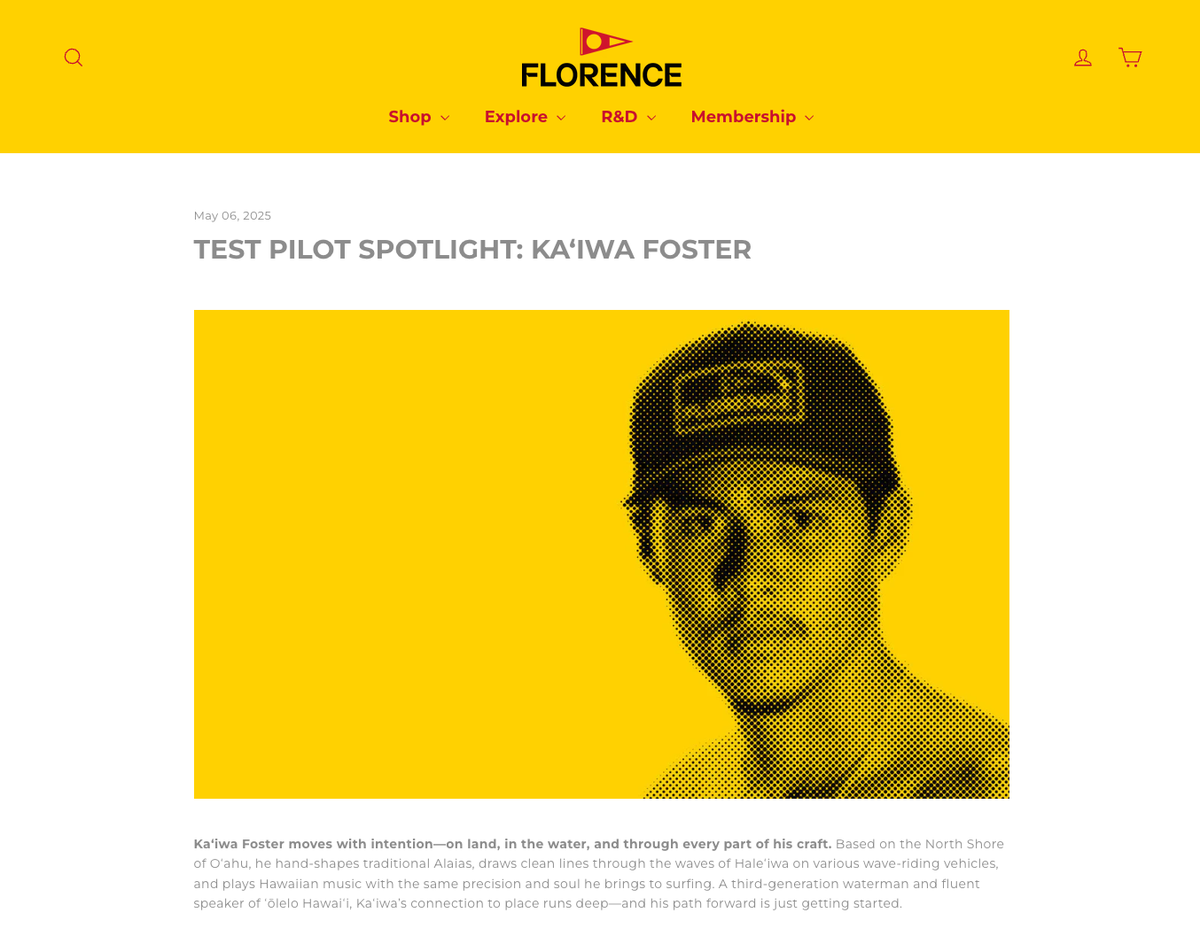
It’s a two-way relationship: they shine the spotlight on their community too
Build the community somewhere it can actually breathe
Florence's Discord has over a thousand members and counting. That's not a staggering number on its face, but it's useful to remember Seth Godin's argument that a thousand true fans is effectively all you need to build something that lasts. Florence is running that playbook, and Shawn was very clear it's not a side channel — it's where a lot of the real brand-building happens.
A few things make it work:
The Florence team are actually in there, as themselves, as moderators. They handle customer service, answer questions, and drop product news. Members can tell they're talking to real people from the brand, not a @support account.
Product drops get announced there first. A collection goes live on the site with no marketing anywhere else, and a link gets dropped in Discord. Members get a head start. That asymmetry is the whole point — membership has to mean something the non-member doesn't get.
There are sub-servers for test pilots (more on them in a second) with their own socialization. Test pilots get a yellow jet pilot helmet badge next to their name and their username renders in yellow in every forum, so everyone in the community can see who's gone through the program.
The reason Discord works here — as opposed to, say, a branded forum or an app — is that it has what Shawn called "really high fidelity communication." It came out of gaming, where people needed to actually talk to each other in real time while playing, and that DNA is still there. It feels like a place where people hang out, not a place brands herd them into.
Turn your most engaged customers into your product development team
The Test Pilot Program is the piece of the Florence playbook I find most worth studying, because it solves two problems at once: it generates genuinely useful product feedback, and it creates the deepest possible brand loyalty in the process.
Six times a year, Florence selects about 30 members to test prototypes. Getting in is competitive — you apply through your membership. If you're accepted, you get a letter in the mail, printed on old thick cardstock, designed to look like a government briefing. "Test pilot, you're now in the program. Here's your letter, document everything, we'll be in touch."
Over the next four to six weeks, test pilots use the prototype in real conditions and log feedback. They meet with the Florence team on a call. Sometimes John John or Nathan joins the call. (Shawn said people occasionally think it's faked — that the face on their screen has to be superimposed. It isn't.)
The feedback actually gets implemented. By the time the product hits the site, test pilots can see their fingerprints on it.
Consider what this accomplishes:
You get real product-market fit data before you ship. Florence's hooded rash guard — one of their signature products — was developed this way. John John himself was the anchor test pilot (fair-skinned, surfing Pipeline, didn't want to keep reapplying reef-damaging sunscreen), and the broader test pilot network stress-tested it across a wider range of conditions and body types. By the time Florence went to market, they already knew the product worked. The marketing job shifts from "convince people this is good" to "tell the story of something that's already proven." That's a vastly easier marketing job.
You create a group of customers with emotional ownership of the product. A test pilot doesn't just buy the rash guard — they helped make it. They'll tell that story to everyone who asks about it.
You give the most passionate slice of your community a visible status marker inside the community. That yellow helmet badge on Discord is a small thing that matters a lot.
The mechanics matter less than the philosophy
If you take the Florence model apart and look at the individual pieces — lifetime membership, sticker pack in the mail, Discord, beta program, members-only sales — none of it is exotic. Most of it is older than ecommerce. What makes the whole thing work is a consistent underlying belief: the membership is an actual offer to the customer, not a pretext to extract more of their data and their dollars.
Shawn put it to me this way when I asked how any of this holds up to a CFO who wants to see attribution on every dollar:
"You always weigh: what is the ROI? But there is an understanding that some things take a little longer. For us, it's really super simply, let's just do the right thing. Let's serve the community. And then if the business continues to grow and people are responding accordingly and our membership is growing — then we're doing something right."
That's a harder position to defend in a spreadsheet than a 3x ROAS. But every apparel brand I talk to right now is running into the same wall: performance is getting more expensive, the one-day click ROI chart looks worse every quarter, and customers are less elastic than the acquisition model assumes they are. At some point the math forces the conversation the Florence team has already been having for three years.

What this means for your program
I'm not going to pretend every apparel brand should copy Florence's program piece for piece. Florence has advantages most brands don't — the founder is genuinely one of the best surfers in the world, they have a natural community to draw from, and they built the program from day one rather than retrofitting it. But the underlying moves are portable:
Make the membership an actual offer, not a discount scheme. Ask yourself what a member gets that a non-member can't get at any price. If the answer is "a bigger discount," you don't have a membership program, you have a coupon.
Get something physical into the customer's hands. A sticker, a patch, a hangtag with a number on it — anything that lives in their world between orders and reminds them they're part of something.
Host the community somewhere it can actually function. Discord is working for a lot of brands right now. So is a well-run SMS channel. The channel matters less than the commitment to show up there as humans, repeatedly.
Let your best customers into your product process. Even a small version — a panel of 20 people who get first look at new products and give feedback — changes the relationship fundamentally.
Hold the line on promotional cadence. If your only lever for engagement is another discount, you've conceded the entire game to whoever is willing to be cheaper.
The Florence program isn't a magic trick. It's a set of unglamorous decisions that compound over a few years. In an environment where every brand is getting squeezed by the same rising performance costs and the same crowded category, the brands that build this kind of infrastructure now are going to look very differently positioned a few years from now than the ones that keep chasing the next channel.
Shawn's line keeps coming back to me: there is no silver bullet. Just the right decision over and over again, and holding the line.
Sunnyside is a performance marketing agency for lifestyle apparel brands. If you're thinking about how to build a more durable marketing engine for your brand, reach out.
Thank you for reading High Tide. Please forward this to your friends.
Follow us on Instagram
.jpg)